Quick answer
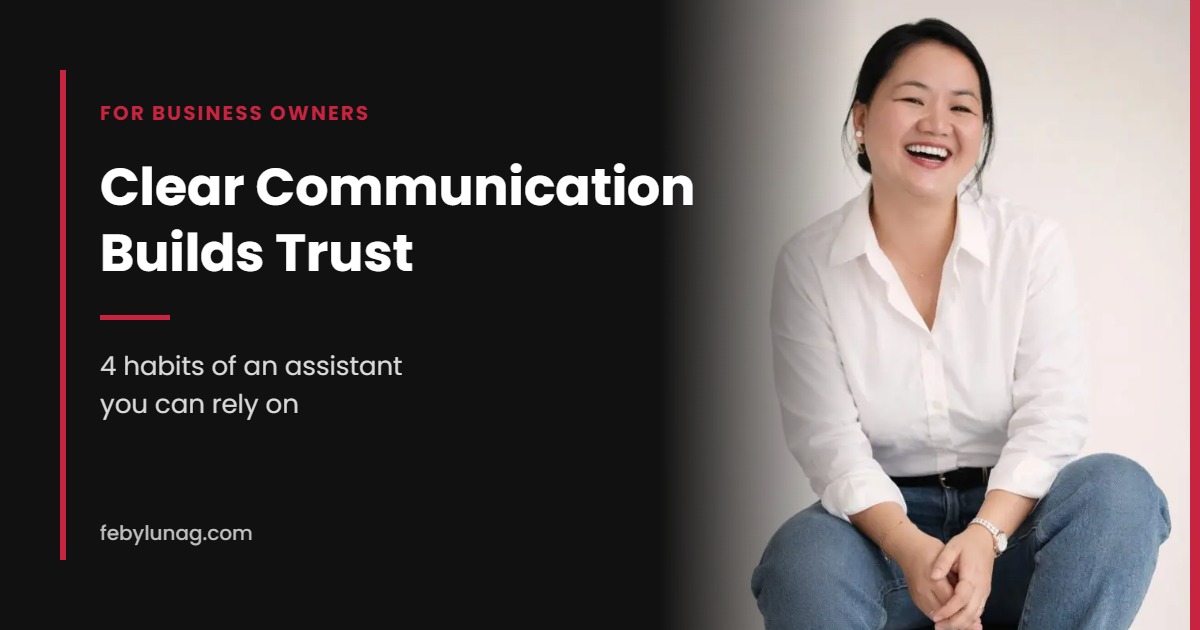
The best assistants aren’t the ones who never make mistakes. They’re the ones who never leave you wondering. Four habits make that happen: they confirm instead of assuming, they report before you ask, they close the loop with a quick “done”, and they bring problems with options.
Skills can be taught. Clear communication is what builds trust.
I’ve worked remotely for more than 13 years. Today I’m the Executive Assistant to a SaaS CEO, and I’ve supported a US publicly listed company for about nine years. Over that time, I’ve noticed that the people business owners trust most are rarely the most technical. They’re the ones who keep you in the loop.
I made a one-minute video about it. Watch it below, then read on for what each habit looks like in real life.
Why communication matters more than skills
When you hand work to someone else, the hardest part isn’t the task. It’s not knowing what’s happening with it. Did they see the message? Did they get stuck? Is it done, or is it sitting in a draft somewhere?
Every time you have to chase an update, you lose a little time and a little trust. A new tool or process can be learned in a week. The habit of keeping you informed is what makes delegation actually feel lighter.
The 4 habits I look for (and practise)
1. Confirm, never assume
If something in a request is unclear, a good assistant asks. A short “Just to confirm, you want this sent to the whole list, not only new subscribers?” takes ten seconds. Guessing wrong can take hours to undo, or worse, reach your customers.
2. Report before you’re asked
You shouldn’t have to wonder how things are going. A quick update, such as “Halfway through the invoices, all on track for Friday”, means you never need to chase. It also gives you a chance to change direction early if priorities shift.
3. Close the loop with a quick “done”
This one is small but powerful. When a task is finished, say so. “Done, the post is scheduled for 9 AM tomorrow.” Without that message, you’re left checking for yourself, which defeats the point of delegating.
4. Bring problems with options
Problems will happen. What matters is how they arrive. “The payment failed” leaves you to figure it out. “The payment failed. I can retry it tomorrow or email the client for a new card. Which do you prefer?” lets you decide in seconds.
A simple test for your next hire
Tip for business owners
When you interview an assistant, give them a small test task with one unclear detail on purpose. Then notice: do they ask about it, or do they guess? That one question tells you a lot about how they’ll work with you.
It’s not a trick. Real work is full of unclear details. You want someone who spots them and checks in, not someone who quietly fills the gaps with their own assumptions.
Make it easy for updates to happen
Communication goes both ways. A few things on your side help a lot: write down what “done” looks like for each task, agree on where updates should go (one channel, not five), and keep tasks, notes and client conversations in one place so nothing gets lost between messages.
I keep my own tasks, client notes and conversations together in Tekmatix. Having everything in one place makes it much easier to report progress and close the loop without digging through inboxes. It has a 7-day free trial if you’d like to try it.
The bottom line
You don’t need an assistant who’s perfect. You need one who never leaves you wondering. Confirm, report, close the loop, and bring options. Those four habits are what turn a helper into someone you can truly rely on.
If you’d like admin help from a team that works this way, meet my FBL Admin Support Team. And if you’re not sure which tasks to hand off first, grab my free AI Admin Audit. It shows you which admin tasks in your business are ready to delegate or automate.